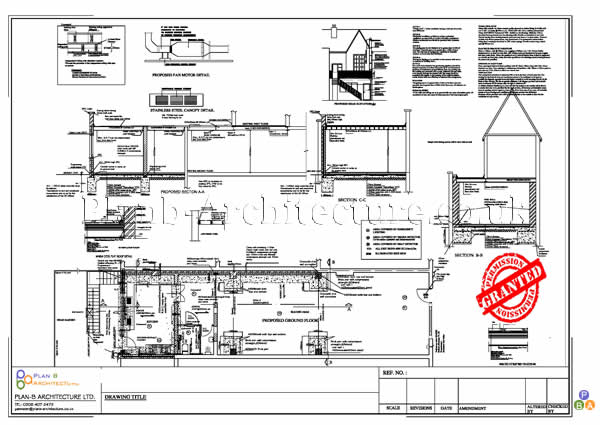
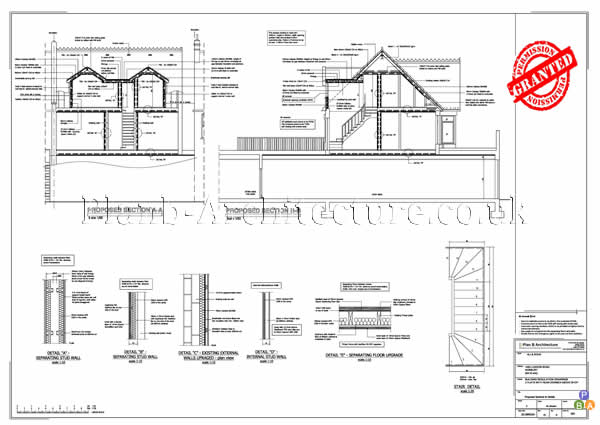
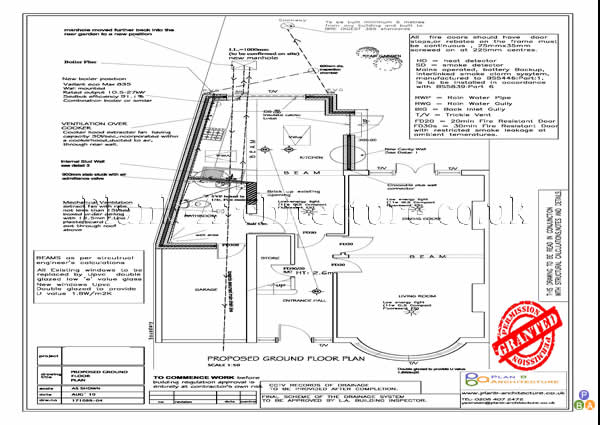
BUILDING REGULATION INFORMATION

BUILDING REGULATION INFORMATION

What are building regulations?

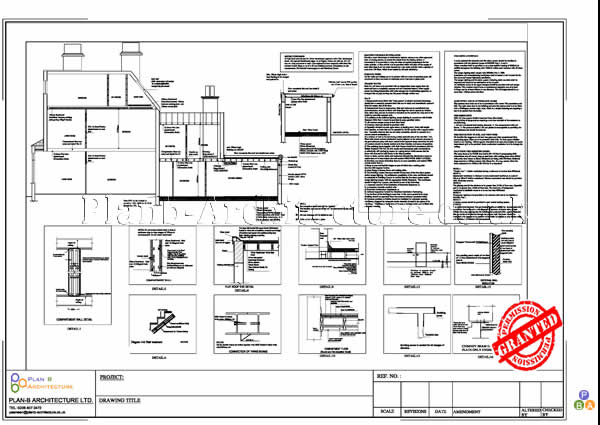
Building Regulations set standards for design and construction which apply to most new buildings and many alterations to existing buildings in England. They exist to ensure the health and safety of people in and around all types of buildings (i.e. domestic, commercial and industrial). They also provide for energy conservation, and access to and use of buildings.

Building regulations are laid out in 14 parts dealing with individual aspects of building design and construction ranging from structural matters, fire safety, and energy conservation –to hygiene, sound insulation, and access to and use of buildings. Not all the functional requirements may apply to your building work, but all those which do apply must be complied with as part of the

overall process of complying with the Building Regulations.

To summarise, Building Regulations will probably apply if you want to:

  • Put up a new building.
  • Extend or alter an existing one.
  • Provide services and/or fittings in a building such as washing and sanitary facilities, hot water cylinders, foul water and rainwater drainage, replacement windows, and fuel burning appliances of any type.

One should bear in mind that complying with the Building Regulations is a separate matter from obtaining planning permission for your work. Similarly, receiving any planning permission which your work may require is not the same as taking action to ensure that it complies with the Building Regulations. 


 Who is responsible for complying with Building Regulations?

Anyone wanting to carry out building work which is subject to the Building Regulations is required by law to make sure it complies with the regulations.( click here for exceptions).The primary responsibility for achieving compliance with the regulations rests with the person carrying out the building work.

You should also bear in mind that if you are the owner of the building, it is ultimately you who may be served with an enforcement notice if the work does not comply with the regulations. So it is important that you choose your builder carefully. Contact us if you require a competent builder.

Fourteen Parts of Building Regulations

The requirements with which building work should comply are contained in Schedule 1 to the Building Regulations and are grouped under the fourteen ‘parts’:

•    Part A – Structure,
 
•    Part B – Fire safety,
 
•    Part C – Site preparation and resistance to moisture,
 
•    Part D – Toxic substances,
 
•    Part E – Resistance to the passage of sound,
 
•    Part F – Ventilation,
 
•    Part G – Hygiene,
 
•    Part H – Drainage and waste disposal
 
•    Part J – Combustion appliances and fuel storage systems,
 
•    Part K – Protection from falling, collision and impact
 
•    Part L – Conservation of fuel and power
 
•    Part M – Access to and use of buildings,
 
•    Part N – Glazing – safety in relation to impact, opening and cleaning
 
•    Part P – Electrical safety. 

WHAT HAPPENS IF YOU CONTRAVENE THE BUILDING REGULATIONS?

The Building Regulations can be contravened by not following the building control procedures they set out for handling your building work, and/or by carrying out building work which does not comply with the requirements contained in the Building Regulations.

If a person carrying out building work contravenes the Building Regulations, the local authority or another person may decide to take them to the magistrates’ court where they could be fined up to £5000 for the contravention, and up to £50 for each day the contravention continues after conviction. For more information on enforcement click here

Few Examples of buildings which are exempt from control under the Building Regulations
1. A detached single storey building, having a floor area which does not exceed 30m2, which contains no sleeping
accommodation and is a building—
      (a) no point of which is less than one metre from the boundary of its curtilage; or
      (b) which is constructed substantially of non-combustible material.


2. A detached building designed and intended to shelter people from the effects of nuclear, chemical or conventional weapons,
and not used for any other purpose, if—
      (a) its floor area does not exceed 30m²; and
      (b) the excavation for the building is no closer to any exposed part of another building or structure than a distance equal to the depth of the excavation plus one metre.


3. A detached building, having a floor area which does not exceed 15m², which contains no sleeping accommodation.
The extension of a building by the addition at ground level of—
     (a) a conservatory, porch, covered yard or covered way; or
     (b) a carport open on at least two sides;


Works not controlled by Building Regulations
 
Vehicle crossovers are controlled by the individual council.

  • Hoarding, scaffold and skip licenses.
  • Erection of boundary fence and boundary walls, but these may be controlled by Planning legislation.
  • Works relating to common areas between two properties may come under Party Wall Act and is not controlled by Building

Regulations.  

  • New driveway or patio areas are not controlled by Building Regulations.
  • If you are carrying out building work personally, it is very important that you understand how the building regulatory system and material applies to your situation as you are responsible for making sure that the work complies with the building regulations.
    If you are carrying out, or having construction or building work done, you may need to notify the  Health & Safety Executive (HSE) and may have other duties as well.

Please call Plan B Architecture Today On 0208 4072472 To Find Out How We Can Help You With Building Regulations And Building Control Application. 

Please click here for Building Regulation FAQ.


PLANNING FAQ

PLANNING FAQ

No, Building Regulations approval is a separate matter from obtaining Planning Permission for your work. Any planning permission approval does not mean that the building complies with the Building Regulations and you will have to take a separate Building Regulation Approval from your Local Authority.

No-The Planning fee and Building Regulation fees made payable to the Local Authority are in addition to our fees.It should be noted that the Council fees varies and is dependant upon the type of proposal. We will advise you of the costs in writing prior to making the submissions. Planning is usually £150.00 where the application relates to one dwelling house.Certificate of Lawful Permitted Development is usually half the amount that would be payable in respect of an application for planning permission for similar works. Building Regulation fees vary from £100.00 onwards based on the type of construction proposed.
What is included in my planning package?

•    Consultation
•    Full property survey
•    2 copies of your existing & proposed conversion plans
•    2 free amendment cover
•    Form completion
•    Application submission
•    Ordinance maps
•    On-line checker service

Once your application has been accepted and validated by the Local Planning Authority, you should receive a formal decision within 8 weeks. Unfortunately Plan B Architecture has no control over the process once the application has been submitted.  However, as your agents we do chase the Local Authority on your behalf to ensure that the application process runs smoothly and we get a timely outcome.
The process for obtaining Building Regulations approvals takes approximately five to six weeks. At Plan B Architecture we usually submit Building Regulation drawings after planning has been granted so that we are sure of the final approved design. It’s only at the client’s request that we submit a Building Regulation application while the Planning application process is ongoing. Being realistic you should allow a minimum of 3 months to obtain both sets of approvals from your local authority.

In a planning application ‘Supporting Documentation’ is usually submitted. In the majority of cases such documentation is a mandatory requirement of your Local Planning Authority (LPA). This will typically consist of location plan, site and other plans, and a design and access statement. It may also include photographs. We are able to provide all of these documents to support your application.

You will need to apply for Planning Permission to extend your property if:
•    the volume of the house would increase by more than 10% or 50m3 (whichever is greater) for  terraced properties.
•    the volume of the house would increase by more than 15% or 70m3 (whichever is greater) for any other house type
•    you live in a conservation area, National park or Area of Outstanding Natural Beauty
•    the extension is closer to any highway than any part of the original house (a footpath is also classed as a highway)
•    the extension is higher then the roof of the original house or is over 4m high (pitched roof) or 3m high (flat roof)
•    you are using over half of your external garden space
•    the building is a Listed Building

These are only general rules for when you will need to apply for Planning Permission, and each project should be looked at individually. We would always advise seeking written confirmation that your development does not require Planning Permission from the Local Authority.Even if you have had no previous extensions, here are some examples of the type of extensions that in most cases need planning permission, to give you an idea:

•    A dormer window in the roof of your house facing the road;
•    A two story extension;
•    A extension to the front of your house, or to the side if it faces a road.

Yes we also provide a pay as you go service with an hourly rate (from £50 per hour) to allow you to fully customise our services.

Yes. This can prove an extremely cost effective approach as we do operate on a pay as you go basis with an hourly rate (from £50 per hour).We will help as much or as little as you require.

We are able to undertake a laser measured survey on your behalf. From this we will provide drawings of the existing condition suitable for a planning application.

Under regulations that came into effect on 1 October 2008 an extension or addition to your house is considered to be permitted development, not requiring an application for planning permission, subject to the following limits and conditions:
•        No more than half the area of land around the “original house” would be covered by additions or other buildings.
•        No extension forward of the principal elevation or side elevation fronting a highway.
•        No extension to be higher than the highest part of the roof.
•        Maximum depth of a single-storey rear extension :3 metres beyond the rear wall for an attached house and 4 metres beyond the rear wall for a detached house.
•        Maximum height of a single-storey rear extension of 4 metres.
•        Maximum depth of a rear extension of more than one storey of 3 metres beyond the rear wall including ground floor.
•        Maximum eaves height of an extension within 2 metres of the boundary of 3 metres.
•        Maximum eaves and ridge height of extension no higher than existing house.
•        Side extensions to be single storey with maximum height of 4 metres and width no more than half that of the original house.
•        Two-storey extensions no closer than 7 metres to rear boundary.
•        Roof pitch of extensions higher than one storey to match existing house.
•        Materials to be similar in appearance to the existing house.
•        No verandas, balconies or raised platforms.
•        Upper-floor, side-facing windows to be obscure-glazed; any opening to be 1.7m above the floor.
•        On designated land no permitted development for rear extensions of more than one storey.
•        On designated land no cladding of the exterior.
•        On designated land no side extensions.

If a building is having an area larger than 120 Square metres it may be suitable for conversion into flats.
While doing a flat conversion a good design makes all the difference as it aims to achieve maximum number of flats possible within the given area and the guidelines.
Plan B Architecture has a significant experience in doing flat conversions .Kindly contact us for more information.

• Large detached or semi-detached properties which are no longer suitable for single family occupation. This may include large terraced housing.
• Other large non-residential properties suitable for conversion subject to compliance with other policies in the Local Plan.
• Any property that is in existing use as bedsits or an HMO which would benefit from upgrading to self-contained flats.
• Any shops with vacant space above.
• Housing in unsustainable locations, i.e. not close to public transport and remote from shops, jobs, schools etc.
• Properties adjacent to ‘bad neighbour’ uses e.g. above or near bars, take-aways or noisy industrial premises.
• Hotels of over 30 bed spaces and hotels in prime holiday areas.

PLANNING PERMISSION APPLICATION PROCESS

PLANNING PERMISSION APPLICATION PROCESS

Plan B Architecture specialises in residential design and planning application process.

We provide a full planning package which includes designing the space, preparing the CAD drawings, preparing and submitting the local authority planning application and tracking it till we get the final outcome.

If you plan to make changes to your house by maybe having an extension, loft conversion or any other type space modification done then we can help you.

If you contact us regarding drawings and planning application then the process will involve the following 3 steps.

1) Free Initial Consultation
2) Design & Drawings
3) Planning Application Submission

1) Free Initial Consultation

We will have a no obligation meeting with you (usually at the site) to assess your design requirements and give you an idea

of the costs involved. It is often best to do this as better advice can be given to you on the feasibility of your project and possibly discover any potential difficulties that may be experienced along the way. We may even suggest alternatives for your review.

Upon your request, we will then send you a formal written quotation detailing the work and the corresponding costs .At this stage we will also advise you of any extra third party expertise your project may require.

Possible third party reports and consultants:
o Party Wall Surveyor
o Structural Engineer
o Traffic & Transportation Reports
o Flood Reports

If you decide to proceed with your home improvement project we will produce your drawings ready for a planning application.Upon your request we can also submit them on your behalf to your council. We will monitor the application and liaise with the planning officer related to your application until outcome of the result.

2. Design & Drawings

After the job agreement, a full measured survey of your property will be carried out. We will then design the space according to your brief and prepare the proposed plans and related drawings. Usually we send the first draft of the drawings to the client before finalising it so that any minor changes can be incorporated in the drawing before issuing it to the Local Authority.

Our planning drawings are prepared according to the planning guidelines of the local authority and contain everything that may be required for a particular project to be successfully passed.

For most cases the drawings comprise of:

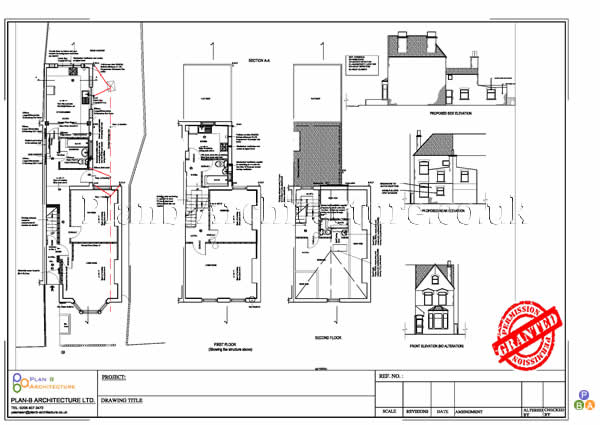
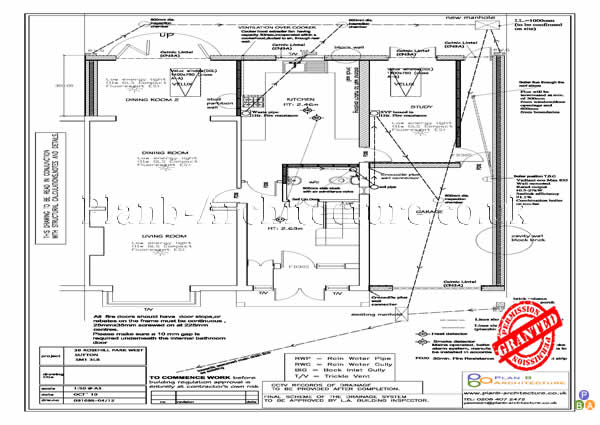
a. Existing and proposed floor plans
b. Existing and proposed elevations
c. Ordnance survey / site location plan
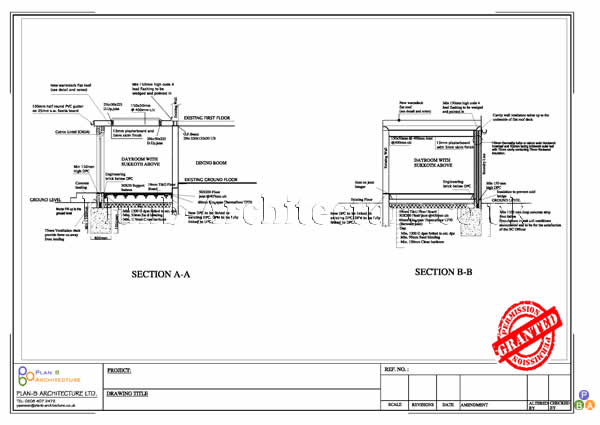
d. Sections as appropriate

3. Planning Application Submission

We then we prepare the planning application forms and submit them to the council on your behalf. We can also produce a “Design & Access Statement” if it is required for a particular project. We will track your application and liaise with the local authority planning officer till we get the result of the application. Any drawing amendments required by the council during the application process will be done free of charge.

Please note that Plan-B Architecture Ltd will act as the client’s agent on all applications unless agreed otherwise with the client. In certain cases we can offer an advisory service on filling in forms with the fee tailored to suit the client.

Please call Plan B Architecture Today On 0208 4072472 To Know More About Planning Process and Planning Application.


PLANNING APPLICATION APPEAL

PLANNING APPLICATION APPEAL

Appeal
If your local authority refuses to grant planning permission for a development, the person who submitted the application can appeal to a Planning Inspector. The Inspector, who is independent of the local authority and the applicant, will then look again at the case, and can either agree with or overturn the local council’s decision.Once a planning decision has been made only the applicant can appeal against that decision.

Appeals of refusals of planning permission are heard and decided by a Planning Inspector. There is no third party right of appeal for other people who disagree with the local council’s decision.The Council’s decision does not have to be final and circumstances other than a refusal, such as onerous conditions or restrictions, can also be appealed. However, time is of the essence as there is a restricted period within which an appeal can be made, which is six months from the date of the decision notice to refuse or 12 weeks in the case of Householder Applications.

In order to achieve the best chance of success an appeal needs to be made early. It is also beneficial to consider engaging professional help as the legal requirements and technical language utilised by the planning authorities, if you are unaccustomed to it, may be confusing. That confusion can lead to an appeal being dismissed rather than allowed.

Anyone can challenge a planning decision in the courts, if they have evidence that the planning decision was not made following the proper procedures. Legal challenges cannot take into account whether the decision was right or not in planning terms, only whether regulations and conventions about making decisions were properly followed. Challenging a planning decision in the courts is a difficult and costly process, and should not be undertaken without specialist legal advice.

An applicant who is refused planning permission, or who finds the conditions attached to the permission unacceptable, has the right to appeal to the Secretary of State for planning.
•    Appeals are heard by independent inspectors from the Planning Inspectorate, an agency of the Department for Communities and Local Government.
•    Inspectors are appointed by the Secretary of State.

When this happens, the local authority is always informed. If you have been involved at the application stage, the authority will notify you, too.

If you haven’t been involved up to this point, you can ask your council’s chief planning officer to let you know if a planning decision that concerns you is being appealed against.

An appeal can be started once
•    The local authority either takes a decision on a planning application that the developer finds unacceptable
•    or hasn’t taken a decision within eight weeks if the application is a minor one, or thirteen weeks if it is a major one
•    or serves an Enforcement Notice on development it believes has flouted planning controls

The applicant must then appeal to the Secretary of State within three months, who then decides a method of appeal. All interested parties organise their evidence and if the case is significant enough, a public inquiry takes place. The inspector will make a formal site visit, and then make a decision on the appeal.

Court challenges
Planning decisions can be challenged in the courts if there is evidence that the process by which the decision was made was unlawful. A court challenge can be very complex, lengthy and costly, however, and shouldn’t be undertaken without legal advice. This section explains how court challenges can be made.

Please call Plan B Architecture Today On 0208 4072472 To Know More About Appeals

If you find yourself in this unfortunate situation, you have come to the right place! Plan B Architecture are here to assist you with your appeal. We understand there are many firms out there offering the same service as us and you may have used one of these firms for your initial application. If you feel Plan B Architecture would be better suited to deal with your appeal please contact us immediately.


PLANNING INFORMATION FOR PLANNING DRAWING AND APPLICATION SUBMISSION

PLANNING INFORMATION FOR PLANNING DRAWING AND APPLICATION SUBMISSION

What is planning?
Planning or planning control is the process of managing the development of land and buildings for any specific area. The purposes of this process is to safeguard the best of our heritage and improve the infrastructure upon which we depend for a civilised existence.

The local planning authority is responsible for deciding whether a development – anything from an extension on a house to a new block of flats – should go ahead. Your local planning authority (LPA) – usually the district or borough council – is responsible for deciding whether a proposed development should be allowed to go ahead.

Each local planning authority has their guidelines for the local development outlining how planning will be managed for that area even if it relates to small houses and householders.

Most types of householder development require planning permission from your local authority. Also, some minor building works– known as permitted development – are automatically allowed.
LPAs can also grant planning permission retrospectively for planning applications submitted after development work has been carried out. Please check our retrospective planning application section for further details.

Under the Planning categories section, we have categorised the type of common developments undertaken by the householders to help you understand the planning process better.

Please do not hesitate to contact us for your specific planning related query. We always provide FREE consultations to your queries.

PLANNING APPLICATIONS

If you intend to start work on property or land that you own it’s your responsibility to seek out the approvals, permissions and consents . As there are quite a few different types of planning applications, we at Plan B Architecture can advise you on which planning application your project would require and the whole process including time scales, cost and what you need to submit.

Most of the householder projects come under the usual range of consents including full planning permission, lawful development certificates, listed building and conservation area consent.

On receipt of a planning application, your local planning authority will firstly check the application to determine whether it’s complete. Once an application has been validated and registered, the local planning authority (LPA) will then publicise and consult on it.

You must also be aware that by law, any planning permission granted expires after a certain period. Please contact us to find out how to extend your permission and other consents you may need before you start any building work.

Please note that Building Regulations approval is a separate matter from obtaining planning permission for your work. To know more about Building Regulations click here.

PLANNING CATEGORIES

Most of the common householders building work and small commercial work involve any of the following planning application and consent.Please click on any of the categories to see the case studies on the projects undertaken by Plan B Architecture.

•    Householder planning
•    Full planning  
•    Conservation area consent
•    Advertisement consent
•    Lawful Development Certificate (LDC)
•    Retrospective Planning  

You will have to ask for permission from your local planning authority if  you intend to do any following building works to your property e.g.

•    Extensions
•    Conservatories
•    Loft conversions
•    Dormer windows
•    Garages
•    outbuildings

Please note that planning permission is not needed for all household building work. Under permitted development rules you can carry out a number of household building work projects, provided they meet certain limits and conditions.

Please call Plan B Architecture Today On 0208 4072472 and we can guide and advise you regarding your building work.